
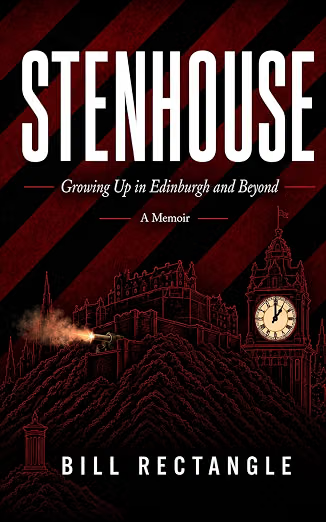
Welcome to the Author Interview. This time, it features the lovely Bill Rectangle author of STENHOUSE: Growing Up in Edinburgh and Beyond.
If you’re an author who’d like to take part in the series, email me: debbie@myrandommusings.co.uk
Now over to Bill.
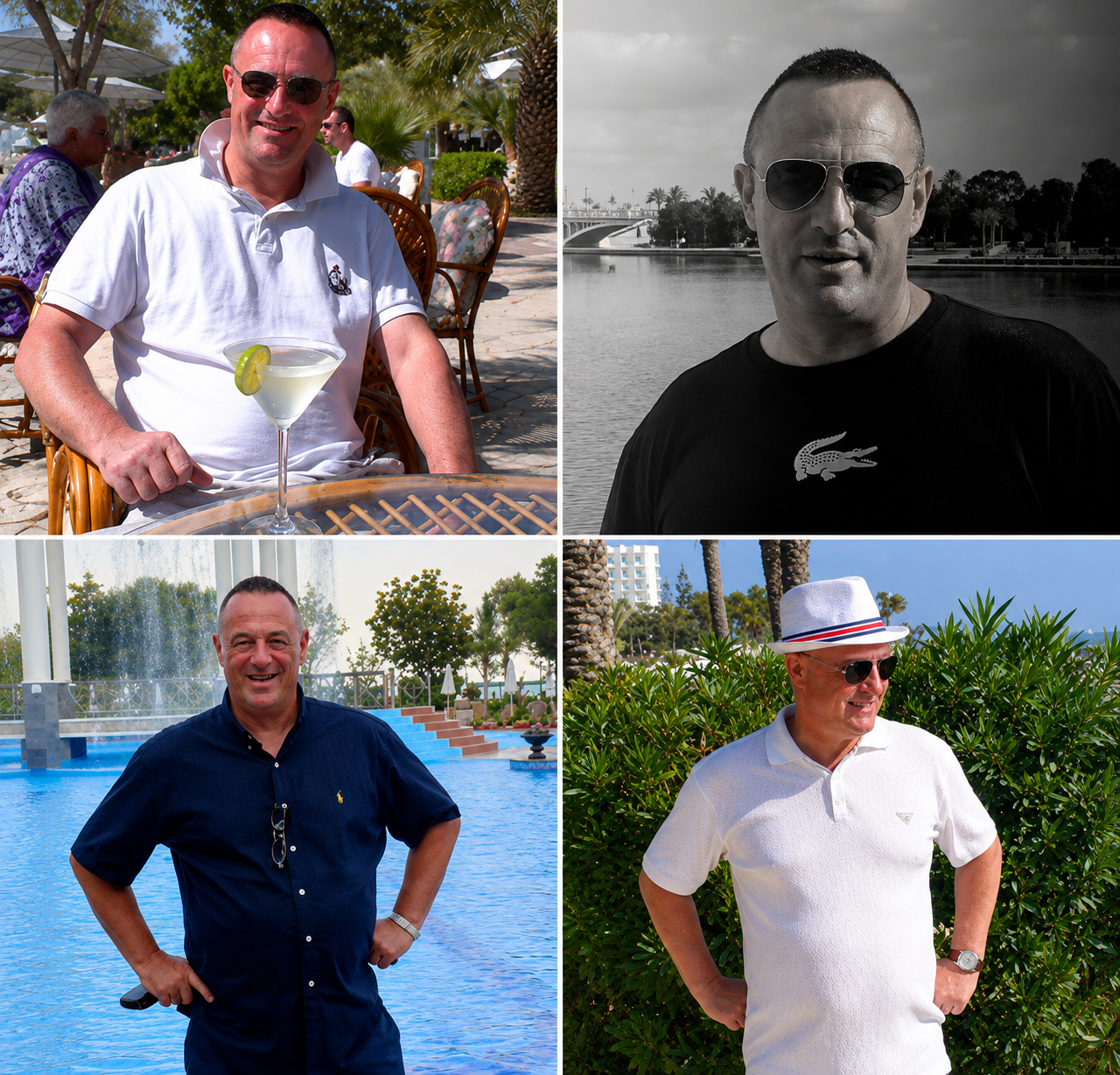
1 Firstly, tell us a little bit about yourself
I’m originally from Edinburgh and grew up in Stenhouse, which ultimately became the inspiration for my first memoir. My partner and I moved out of Edinburgh to West Lothian, where we’ve now lived for around twenty six years, and we’ve been together since 1999.
Professionally, my background is in IT and technology, an area I’ve been involved with for more than thirty years. I’m very much an autodidactic lifelong learner. I enjoy exploring and teaching myself new things independently and then, where appropriate, developing that knowledge further through formal professional training and qualifications.
More recently, that curiosity has extended deeply into AI, which I’ve been exploring both professionally and personally for around two years. That eventually became part of a much wider creative experiment when I decided to write STENHOUSE: Growing Up in Edinburgh and Beyond, independently publish it through White Hat Media and personally narrate the complete audiobook.
Away from work and writing, I’ve always enjoyed active interests. I skateboarded when I was younger, I’m a skier and snowboarder, and I’m also trying to learn to surf. I think there’s probably a common thread running through all of it: I enjoy learning, experimenting and seeing how far I can take something.
2. Tell us a little bit about your book
STENHOUSE: Growing Up in Edinburgh and Beyond is my first independently authored and published memoir. It follows my life from roughly the age of three through to sixteen, growing up in Stenhouse, Edinburgh during the 1980s and into the early 1990s.
It covers family, friendships, school days, football, skateboarding, skiing, ice skating, music and early technology, alongside the funny moments, local characters and everyday adventures that made up growing up during that period.
I also wanted the memoir to be honest. There are tougher experiences and lessons learned alongside the good times, but I deliberately didn’t want to dwell entirely on the negatives. I wanted something relatable that might make readers of different ages think about their own childhood, friendships, families and the places where they grew up.
The book is available in paperback and Kindle editions, and I personally narrated the complete audiobook, which runs for more than eight hours. That was important to me because these are my own memories, so hearing them told in my own Edinburgh voice adds another personal dimension to the story.
3 Where do you find your inspiration for your books?
The biggest inspiration was my own life and the people and places around me. STENHOUSE started with my memories of growing up in Edinburgh, particularly Stenhouse, but once I began looking back properly, I realised how many memories can be triggered by something very small: a photograph, a piece of music, revisiting a place, an old piece of technology or simply talking to somebody who was there at the time.
My family and friends have been a huge part of that. Since STENHOUSE was published, their support and encouragement have been fantastic. Conversations with people about the book have actually brought back additional memories and stories I’d almost forgotten, which is one reason I’m now considering whether there could eventually be a second collection of shorter stories extending the period covered by the first book.
Ultimately, though, my own life remains the single source of truth for the memoir. Other people can remind me of something or help trigger a memory, and technology can help me organise and develop the project, but the experiences and the meaning I give to them have to come from me. That’s important because I wanted STENHOUSE to remain an honest account rather than turn my past into something it wasn’t.
4 What, for you, is the best thing about being a writer?
There are several things, but probably the most personally meaningful is seeing where the journey has taken me. As a child I needed additional support with aspects of reading and writing, so to eventually reach the point where I could write, independently publish and personally narrate my own full memoir is something I’m very proud of.
I had thought about writing a book for many years, and writers such as Irvine Welsh helped inspire that ambition. Coming from Edinburgh myself, there was something powerful about seeing familiar places, language and environments represented in literature, even though my own experiences and the story I wanted to tell were very different.
Another major motivation was technology. I have more than thirty years of experience around IT and technology and, as AI began advancing rapidly, I realised that creating my own original body of material would give me something incredibly interesting to work with in the future. My own life is the single source of truth, and STENHOUSE is now my own original source material.
That means the book doesn’t necessarily have to end with the book. As AI and other creative technologies continue to develop, I could potentially adapt my own material into completely different forms. There are adaptations I’m already considering for different age groups, and perhaps a few years from now the technology will have advanced far enough that I could experiment with turning STENHOUSE into my own independent film adaptation. That possibility was actually part of what gave me the final push to stop simply thinking about writing the book and actually create it.
I also love when readers recognise something from their own lives in my experiences. Somebody doesn’t need to have grown up in Stenhouse to relate to family, friendships, school, growing up, difficult moments or the funny things we did as children. Being able to preserve my memories while also triggering memories and conversations for other people is probably the most rewarding part.
5 And the worst?
I genuinely don’t think there has been a worst part for me. I tend to look at the whole process as a learning experience. Even when something is difficult, takes longer than expected or doesn’t work the first time, I’ve learned something from doing it.
Writing the book, independently publishing it, narrating the audiobook, building the promotional material and then learning how to market it have all presented different challenges, but that’s part of what I’ve enjoyed about the project. I’m an autodidactic lifelong learner by nature, so I don’t really view those challenges as negatives. If something doesn’t work, I learn why, change the approach and try again. For me, that’s part of the fun.
6 If you could have any super power, what would it be and why?
If I could choose one, probably flying. I think the freedom of being able to take off and see the world from above would be incredible. Healing would be a very close second because of the good you could do for other people, followed by teleportation, which would certainly make getting around easier! Super intelligence would traditionally have been high on my list too, although in an interesting way I think AI is already giving ordinary people access to something approaching a form of enhanced intelligence and knowledge, provided we use it responsibly. So, these days I’d put that fourth.
7 Do you have any tips for anyone wanting to write their first book?
Just give it a try. You can always make it better. I think one of the biggest barriers to doing something new is worrying about whether you’ll get it right before you’ve even started.
I’ve always had a fairly simple philosophy whenever I try something new: “What’s the worst thing that could happen?” I genuinely think about that question, work out what the realistic worst outcome is, and come to terms with it. Once I’ve accepted that possibility, much of the fear disappears. That approach has given me confidence throughout my life when stepping into things I haven’t done before.
Writing my first book was another example. You don’t need to know everything at the beginning. Start with something that’s genuinely yours, get your ideas down and improve them as you go. Keep learning, take advice, use the tools available to you and don’t be frightened of making mistakes.
Modern technology and AI can also be fantastic enabling tools, particularly for an independent creator, but I believe your own ideas, experiences and judgement should remain the single source of truth. The technology should help you express and develop what is yours, rather than take away the reason for creating it in the first place.
And remember that finishing something imperfect gives you something you can improve. An idea you never start can’t get better.
8 Tell us one random fact about you
One random fact about me is that I’m very much an autodidactic lifelong learner. I tend to teach myself and explore subjects independently first, getting as much as I can from them before progressing into formal training where appropriate. That approach has followed me throughout my life, particularly with technology and, more recently, AI.
The same curiosity carries over into my hobbies. Although I’m right-handed, my mum was left-handed and I’m quite ambidextrous in certain things. I skateboarded when I was younger, and these days I ski and snowboard, and I’m also trying to learn to surf. With skateboarding, snowboarding and surfing I naturally use a goofy stance, with my right foot forward.
9 Who is your favourite author?
Stephen King has always been an author I’ve admired, but Irvine Welsh was particularly inspiring to me as a writer because of the Edinburgh connection. I could relate to the places, atmosphere, language and some of the things happening around the city. My own upbringing and story are very different from the drug culture portrayed in works such as Trainspotting, and I wasn’t directly involved in that world, but I recognised the wider environment and could relate to seeing some of those sorts of things happening around me. There was something powerful about seeing Edinburgh represented through the experiences and voices of people who actually knew the city. That helped inspire me to realise that the places and experiences I grew up with could also form the basis of a story worth telling.
10 And your favourite book(s)?
Some of the books that have stayed with me most are actually connected to the beginning of my career. One of the first full books I remember reading while at college was a small paperback called How to Bluff Your Way in Computers. I was studying computing at the time, so it was an amusing but memorable early read.
At the beginning of my working career in IT, when I was moving into end-user support and then Microsoft MCP and engineering work, I also bought Bill Gates’ The Road Ahead. That one particularly sticks in my mind because I was reading about where technology might be going while I was actually beginning my own career in the industry.
On the fiction side, Stephen King has been an influence, and Irvine Welsh’s work resonated with me in a different way because of that Edinburgh connection and recognition of the environment around which some of his stories were set.
11 What book are you reading right now?
These days I actually consume more audiobooks, podcasts and informative YouTube content than traditional books. I’m a lifelong learner, so I tend to follow whatever subject has caught my interest at the time.
Recently I’ve been listening to Acid for the Squares and the remote-viewing podcast The Signal Line. I find subjects such as remote viewing, ESP and human consciousness fascinating, while recognising that some of these areas remain debated or scientifically uncertain. I also enjoy following legitimate clinical research into psychedelics, including DMT, and their potential therapeutic applications.
Another major interest is the rapid development of AI and how it is assisting humans with medical and scientific breakthroughs. I’m particularly interested in AI as an enabling tool that can enhance human capabilities rather than replace the human element.
12 Where is your favourite place to write?
My usual place to write is our dining room, where I have my workstation set up with three monitors. That gives me plenty of space for writing, research and having different sources or tools available at the same time.
The idea stage is completely different, though. An idea can come to me virtually anywhere, so I’ll often use my mobile phone to capture a thought before I forget it. The obvious exception is when I’m driving or doing anything potentially dangerous or that requires my full attention. At those times I put the technology away and stay completely in the moment.
13 Do you prefer to write in silence, or do you have a writing soundtrack?
I generally need silence when I’m properly in the zone. I really dislike noise and distractions when I’m concentrating because once I’m immersed in something, I like to stay focused on it. That said, complete silence isn’t always possible, so I’ll sometimes play ambient, chilled electronic music in the background. I find that can smooth out the surrounding distractions without demanding my attention and actually helps me maintain that focused state.
14 What can we expect from you next?
There are a few possibilities, but I’m deliberately not rushing any of them. Later in 2026, I’m considering adaptations of STENHOUSE aimed at making the story accessible to a broader range of ages, including a primary-school-age adaptation and a version for younger readers. I like the idea that the same underlying memories and experiences can be presented appropriately for different generations.
Something else I’m now considering is a second collection of short stories from the same period covered by the first STENHOUSE book. The support from friends and family since publication has been fantastic, and conversations with people who remember those years have reminded me of additional stories and experiences that weren’t included in the original memoir. There may now be enough worthwhile material to create a companion or extension to that first period.
Further ahead, I’m considering the second main stage of the memoir, potentially later in 2027, picking up from where the first STENHOUSE period ends. I’m still deciding exactly what form that will take and how deeply I want to go into that next part of my life, so I don’t want to promise a book or publication date before I’m ready.
Over the next twelve to eighteen months I also have significant professional commitments, including formal cybersecurity training alongside my full-time IT career. So, I’m deliberately giving myself room to enjoy STENHOUSE, take part in interviews and other interesting opportunities, develop the adaptations, and see naturally where the response to the first book takes me.
15 Anything else you’d like to share with us?
One aspect of STENHOUSE that has been particularly interesting for me is the technology behind the project. I’ve worked with computers and technology for more than thirty years and have spent roughly the last two years exploring AI both professionally and personally. With STENHOUSE, I wanted to see how these newer technologies could genuinely enable an independent creative person rather than replace them.
I approached my own lived experience as the single source of truth. The memories, experiences, opinions and decisions had to remain mine. Technology could assist me with things such as organisation, checking, presentation and the practical workload involved in independently creating, publishing and marketing a project, but it couldn’t have lived my life for me or decide what those experiences meant.
In that sense, STENHOUSE became something of a personal experiment as well as a memoir. I wanted to see how far one person could take an authentic creative project by combining their own knowledge and experience with modern technology as an enabling tool. I independently authored and published the book through White Hat Media and then personally narrated the complete audiobook, so maintaining that human connection throughout the project was important to me.
I think we’re entering a fascinating period where technology and AI can give artists, writers and other professionals capabilities that previously required much larger teams or resources. For me, the important part is keeping the human being responsible for the source material, judgement and final creative decisions. Used that way, I see AI as something that can extend human capability rather than replace it.
16 Where can we find you? (Links to your Amazon page and social media)
The official STENHOUSE / White Hat Media website, Amazon (paperback, Kindle and audio), YouTube and Instagram.
Leave a Reply